
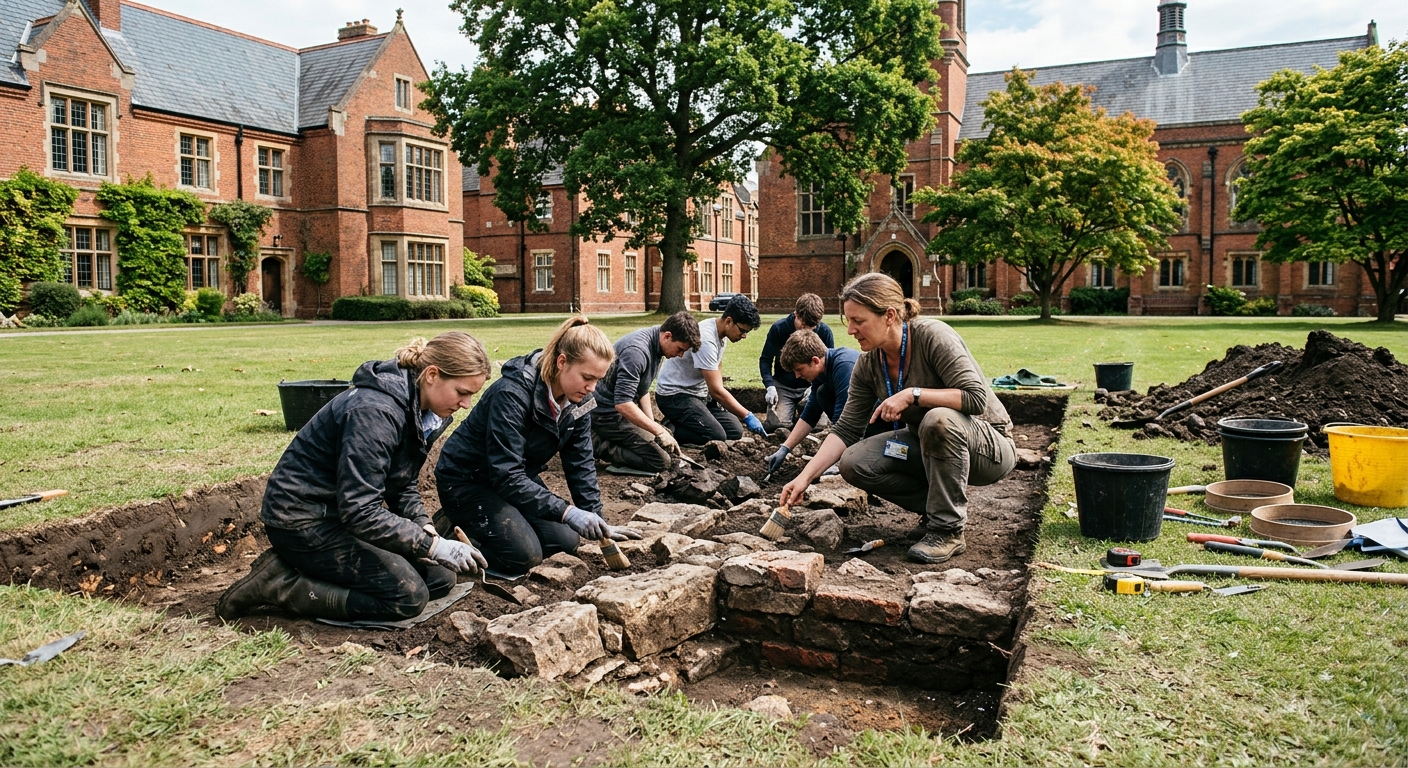
AI-generated illustration; not a photograph of the reported event.
- calendar_today October 20, 2026
Historic Search for Acadia University's Earliest Building
Sixteen students at Acadia University in Wolfville, Nova Scotia, have started an archaeological excavation on their campus. Their mission: to uncover the original foundations of Acadia's very first College Hall, a building constructed in 1844 and destroyed by fire in 1877. The search is part of their coursework in a class called History and Archaeology of Acadia, supported by an interdisciplinary initiative known as Digging for Acadia.
Challenges in Locating First College Hall
Finding the precise spot where the first College Hall once stood has proven difficult. Wendy Robicheau, Acadia University's archivist and a co-director of the project, began looking for clues about the lost building prior to 2022. While combing through historical photographs and maps, she discovered that major changes to the campus over the past century have made it challenging to pinpoint the location. Robicheau noted, "We do not have reliable records as to where it was located. So there's only one way to find out is to dig in the ground and go look for it."
Combining Archival and Geophysical Techniques
The project leverages both archival research and modern geophysical methods. Alongside Robicheau, geologist Mo Snyder serves as the other project co-director, guiding the students through practical fieldwork. The team uses techniques such as reading the landscape and employing ground-penetrating radar to detect hidden subsurface features potentially related to the historical foundations. According to Snyder, discoveries like these are rare in Nova Scotia: "You could dig a hole in a lot of places and not find something, especially this close to the surface."
Notable Discoveries During the Excavation
Recent efforts led to the uncovering of stone foundations believed to be part of a lost well, along with gravel likely used to fill it in. Further testing is planned to determine whether this structure is connected to the original College Hall. Student Alice Godelie shared her excitement after finding a red brick during a dig, describing the moment as exhilarating since it was the first significant artifact she'd found.
A Broader Look at Acadia's Historic Campus
Acadia University was founded in 1838, and Seminary House, built in 1878, is now its oldest surviving structure. Before the first College Hall's construction, faculty and students shared space with the original Horton Academy. Robicheau hopes the Digging for Acadia project will also shed light on other lost structures from the university's early years, saying, "I think it's very important to understand the development of the campus and to really understand how our history has grown over this time and to get a sense of the place that we're in."
Continuing Fieldwork and Educational Opportunities
The excavation remains in its early stages, with students digging test pits across various parts of the campus property. This hands-on experience in fieldwork represents a unique educational opportunity, blending acadia university history, archaeology, and archival research. As the team continues their search, they aim to further understanding of historic campus buildings and the university's development through time.
Source: cbc.ca.