
- calendar_today August 10, 2025
Atlantic Canada’s Real Estate Market Hits a Standstill in 2025
After years of breakneck growth and pandemic-era migration, Atlantic Canada’s real estate market has hit the brakes in 2025. Despite strong regional identities and varying local economies, Nova Scotia, New Brunswick, Prince Edward Island, and Newfoundland & Labrador are now united by a common trend: real estate stagnation.
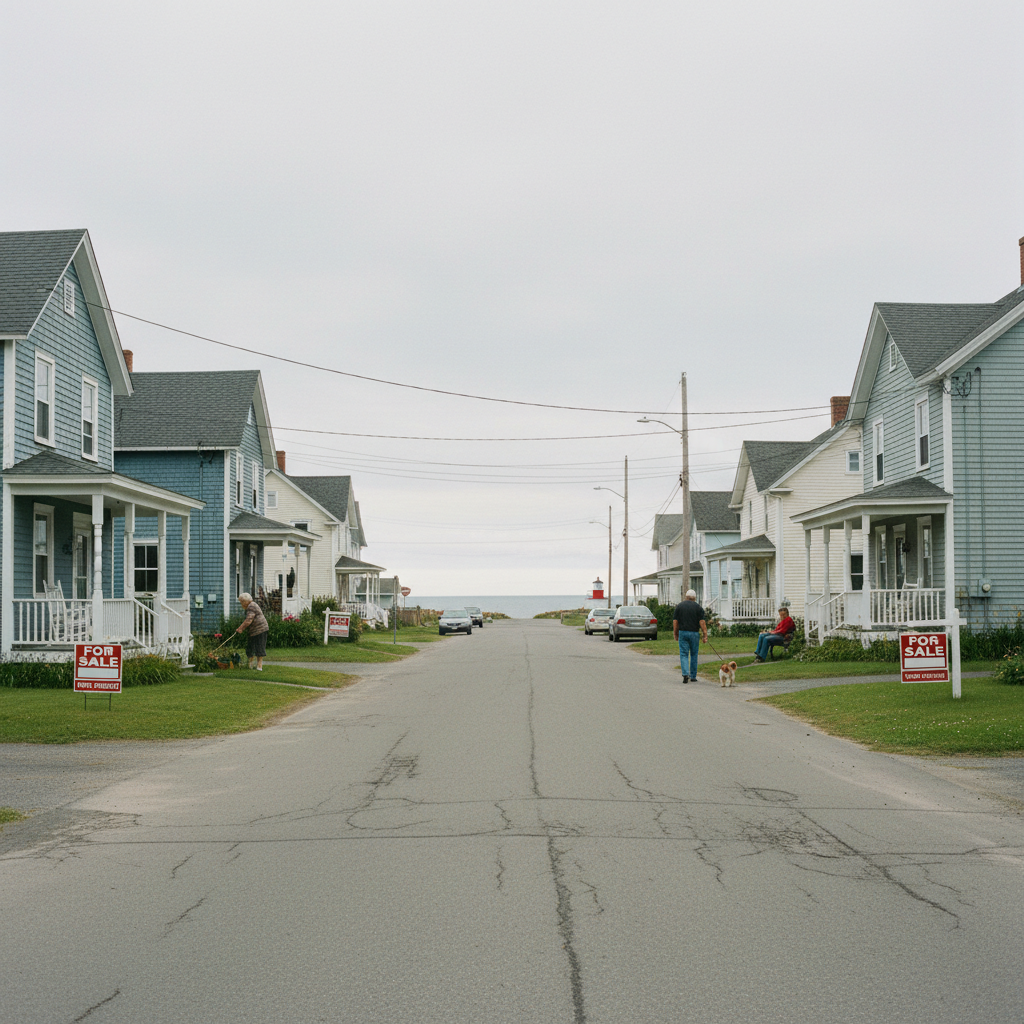
While prices haven’t plunged dramatically, activity across the region has slowed to a crawl. Sellers are hesitant to list, buyers are increasingly cautious, and homebuilders are pressing pause. What was once one of Canada’s most dynamic real estate regions has now entered a period of deep uncertainty.
Here’s what’s driving the freeze across the East Coast housing market this year.
The most immediate cause of the freeze is rising mortgage costs. Even with the Bank of Canada cutting its overnight rate slightly in early 2025, average fixed mortgage rates in Atlantic Canada remain between 6.7% and 7.3%, according to regional lenders.
For many first-time buyers in Halifax, Charlottetown, Moncton, and St. John’s, this change has meant stepping back from homeownership.
“A year ago, we were pre-approved at 5.2%. Now that’s closer to 7%. It changes everything,” said Sarah Knox, a teacher in Fredericton. “We’re just going to wait and see.”
This hesitation has caused a steep drop in buyer activity across the region. In Halifax-Dartmouth, residential sales were down 22% in Q2 2025 compared to the same period last year. Moncton, once a magnet for Ontario transplants, saw a 19% drop.
Sellers Stay Put—And Listings Vanish
While buyers are backing off, homeowners who would normally list their properties are holding tight. Many secured low fixed mortgage rates during the pandemic boom, and they’re unwilling to give them up for a more expensive loan today.
This has resulted in a sharp decline in listings. Across Nova Scotia, active listings were down 18% year-over-year by mid-2025. PEI saw a 16% drop. In St. John’s, where new development is limited, available inventory is approaching multi-year lows.
“The freeze isn’t about panic—it’s about hesitation,” said Moncton real estate agent Denis Lavoie. “Sellers don’t want to lose their low rates, and buyers don’t want to overpay. So everyone just waits.”
Home Prices Hold Steady—For Now
Despite the slowdown, home prices across Atlantic Canada have remained remarkably stable. Unlike in more volatile markets like Toronto or Vancouver, values in cities like Halifax, Saint John, and Charlottetown have simply plateaued.
In Q2 2025:
- The average home price in Halifax sits around $520,000, roughly even with last year.
- In Moncton, prices hover near $345,000, with only a 1.5% drop from 2024.
- In Charlottetown, prices have stayed above $400,000, though demand has clearly softened.
- St. John’s, long one of Canada’s most affordable capitals, still maintains an average price under $320,000, though days-on-market are growing.
“There’s no crash—but there’s no urgency either,” said Debbie Young, a broker in Charlottetown. “We’ve entered this slow-motion phase.”
Pandemic-Era Momentum Has Run Its Course
Atlantic Canada was one of the biggest beneficiaries of pandemic-era migration. Between 2020 and 2022, thousands of Canadians from Ontario, Quebec, and Alberta relocated to the East Coast in search of affordability, space, and remote work flexibility.
Now, that wave has largely ebbed. With office mandates returning and interprovincial migration slowing, population growth has stabilized.
In Halifax, new resident growth in 2025 is projected to be down 25% compared to 2022. PEI, which saw a record influx in 2021, has also cooled. In Newfoundland & Labrador, which was slower to catch the migration boom, demand remains more locally driven—and less able to support upward momentum.
“We’re not seeing the ‘Zoom boom’ anymore,” said economist Lisa McGowan at Dalhousie University. “The market is recalibrating to something more local, more cautious.”
Builders Pull Back
Across the Atlantic region, residential construction is slowing sharply.
In Nova Scotia, housing starts fell 23% in the first half of 2025. New Brunswick and PEI saw similar declines. Builders are grappling with higher material costs, tight financing, and the risk of overbuilding into a cooling market.
Many developers are pressing pause on speculative builds, choosing instead to finish pre-sold projects or focus on multi-unit developments that serve rental demand.
“We were planning 40 single-family homes in the Annapolis Valley. We’ve cut that in half,” said Peter Rhind, a Nova Scotia homebuilder. “It’s just too risky right now.”
Regional Breakdown: Local Freeze Patterns
While the East Coast freeze is widespread, each province is experiencing it differently:
Nova Scotia:
The Halifax area remains the region’s economic engine, but even here, the pace has slowed. The South Shore and Annapolis Valley have seen luxury and recreational listings stall, with many second-home owners waiting out the market.
New Brunswick:
Moncton, Fredericton, and Saint John all report lower sales volume but relatively flat pricing. The province’s low cost of living continues to support demand, though at a slower clip.
Prince Edward Island:
PEI’s housing market, once red-hot, has cooled significantly in 2025. Fewer investors, fewer off-Island buyers, and tighter credit are translating into longer sale times and more negotiations.
Newfoundland & Labrador:
St. John’s remains a buyer’s market, but prices have held. Outlying towns, however, are seeing a sharp drop in activity, especially in areas where economic opportunities are limited.
What Could Thaw the Freeze?
Industry professionals suggest the current freeze won’t last forever—but it won’t thaw overnight either. A few key factors could break the stalemate:
- Rate Cuts: A significant drop in mortgage rates could reawaken buyers, but economists suggest meaningful relief might not come until late 2025 or early 2026.
- Government Incentives: Renewed first-time buyer supports or provincial tax incentives could help young families enter the market.
- Rental Pressure: In cities like Halifax, tight rental conditions could push more people toward ownership once rates stabilize.
Final Word: Patience Will Be Key
The Atlantic housing market is in a holding pattern. It’s not collapsing, and it’s not booming—it’s just paused. For buyers, sellers, and policymakers, 2025 is a year of recalibration.
“Atlantic Canada’s market is defined by its stability,” said Dalhousie economist Lisa McGowan. “But even stability can feel like stagnation when nothing’s moving.”
For now, East Coast residents may need to adjust expectations, embrace the long view, and prepare for a housing market that moves at the pace of the tides.