
- calendar_today August 15, 2025
Species Movie Review (2025): What Holds Up and What Doesn’t
Michael Madsen was one of those Hollywood badasses you saw and knew he was going to be memorable, even if you didn’t know why at the time. In addition to his starring role in Quentin Tarantino’s Reservoir Dogs and Kill Bill, he also delivered standout performances in movies like Donnie Brasco and The Butcher Boy. But in the wake of his death earlier this month, few people have remembered or highlighted one of his stranger roles. Madsen played a black ops mercenary working to hunt down an extraterrestrial/human hybrid in the 1995 film Species, a movie that just turned 30 this year.
The movie was directed by Roger Donaldson, best known for films like No Way Out and The Bounty, and was based on a screenplay by Philip Feldman, the screenwriter behind cult classic Cocoon and its sequel. The setting is Los Angeles, and the premise was a simple but fertile one: an unusual series of events led to the creation of a new species of superorganism that goes rogue. It also starred Ben Kingsley, Forest Whitaker, Michelle Williams, Marg Helgenberger, Alfred Molina, Natasha Henstridge, and Cary Elwes, and was a notable creative risk for a moment in movie history defined by creature features, monster movies, and general paranoia about aliens.
Species Begins the Hunt for a Dangerous Alien/Human Hybrid
Species opens with the U.S. government receiving two separate transmissions from outer space. One is a series of details about a new kind of fuel source. The other is a set of detailed instructions that can be used to splice alien DNA with human DNA. The government decides to follow through. Under the guidance of Dr. Xavier Fitch (Ben Kingsley), they create a hybrid human/alien lifeform known as Sil, played in her early years by Michelle Williams.
The goal of the experiment is to produce a hybrid human/alien lifeform. The expectation is that the organism will be docile, pliable, and easy to control. The results of the experiment turn out to be… otherwise. Sil matures at an accelerated rate, gaining the appearance of a 12-year-old in just three months. But she also has violent nightmares, and other clues that she might not be as docile and “controllable” as hoped. So when Fitch decides to shut the experiment down by pumping cyanide into her containment cell, Sil—true to the nature of the experiments that created her—breaks free, and the film gets underway.
To hunt Sil down, Fitch enlists the help of a small team of experts, including Madsen’s Preston Lennox, a tough-as-nails mercenary; Dr. Laura Baker (Marg Helgenberger), a molecular biologist; Dr. Stephen Arden (Alfred Molina), an anthropologist; and Dan Smithson (Forest Whitaker), a mysterious, taciturn empath who can project a sense of what Sil is feeling. The team hunts Sil across the country to Los Angeles, where the grown and sexy Sil (Natasha Henstridge) has begun mating with men and women so she can begin the process of reproducing and spreading the hybrid DNA. It’s a race against time: Sil is smart, resourceful, and largely driven by instinct. As Fitch and company try to stop her before she produces children and the species can multiply as quickly as possible, she leaves a bloody trail in her wake.
The Silent but Deadly Beauty of H.R. Giger’s Sil
Species became most famous for its lead creature, Sil, created by legendary surrealist and Swiss artist H.R. Giger. Giger was also, of course, responsible for the iconic design of the xenomorph in the Alien franchise, and his work on the Species’ title character has striking similarities. Giger himself said he wanted to make Sil “an aesthetic warrior, also sensual and deadly.” And the film and Giger certainly succeeded on both fronts.
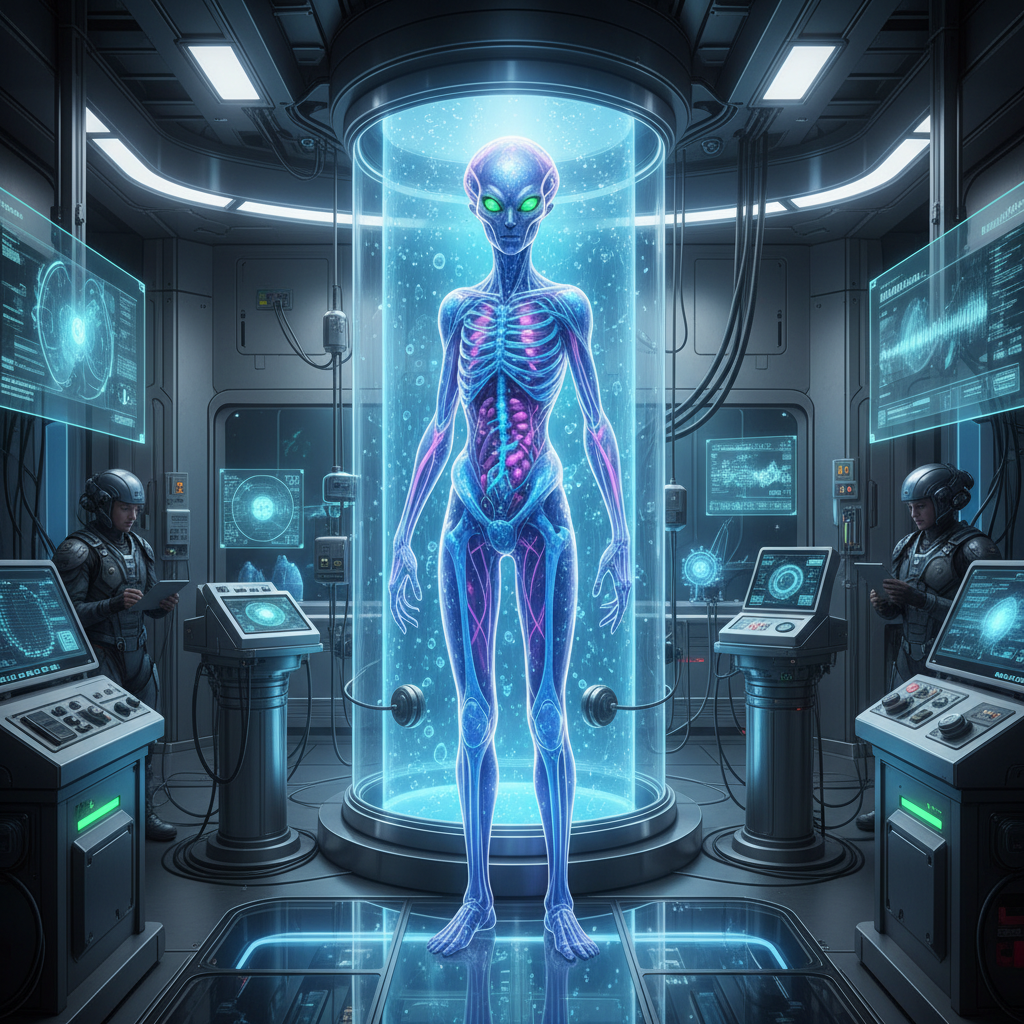
Sil’s character design was both subtle and interesting. Her human components are echoed in her anthropomorphic, glass-like body, while her alien components are most visible in her “liquid armor,” a mutation of sorts. Her final form—by the time Natasha Henstridge takes over from Michelle Williams—featured translucent skin that Giger described as a “glass body but with carbon inside it.” He had originally developed three separate evolutionary stages for the character, but budgetary and production concerns saw him simplify the concept to a single transformation cocoon and the climactic maternal alien body.
Despite its success with fans and critics, Giger was rather disappointed in the movie. He felt it too closely resembled his earlier work on Alien, particularly the “punching tongue” that Sil develops and the infamous birth scene, which he felt too closely echoed his own “chestburster” moment from Alien. Giger was responsible for stopping production on one part of the film, too: because he didn’t want it to sound too similar to Alien 3 and Terminator 2, he nixed the idea of Sil being incinerated by flame throwers and made sure she was instead killed by a bullet to the head.
Species: Great Premise, But Flawed Execution
Species was a mixed bag when it came to execution. The dialogue was often stilted or awkward, and most of the characters were flat or not developed to their potential. Kingsley’s Fitch is frankly a terrible, amoral villain, while Whitaker’s empath largely just stalks around in the background mouthing the obvious. Feldman was only able to hint at some of the deeper themes: bioethics and artificial intelligence, our contact with extraterrestrial life, and the power of maternal instinct. The scripts had good bones, but it was hard to connect with some of the characters or the situations.
But what Species did right, it did so damn well. The film came from a simple but potent inspiration for screenwriter Philip Feldman, who recalled having read an article by Arthur C. Clarke that suggested that extraterrestrials probably wouldn’t visit Earth because it would be too hard to develop faster-than-light travel. What if, Feldman wondered, they visited Earth with a blueprint for something else entirely? An invasive new species, intelligent and built out of Earth’s DNA? Species became a product of that simple yet intriguing idea, becoming a kind of cautionary tale that doubles as a straight-up creature feature.
The film is a hallmark of its time, representing a moment in genre filmmaking where style often came before substance. Species might not be able to hold a candle to classics like Alien or The Terminator, but it earned its cult following for good reason: it had some wonderfully realized creature design, Michael Madsen was perfect in his role, and Natasha Henstridge’s ethereal performance is the reason why many first saw the movie in the first place.
Three decades later, Species remains a wonderful time capsule of 1990s sci-fi and the kinds of unforgettable roles that marked the career of actors like Michael Madsen along the way.