- calendar_today August 10, 2025
Fire threatens one of America’s most bizarre museums
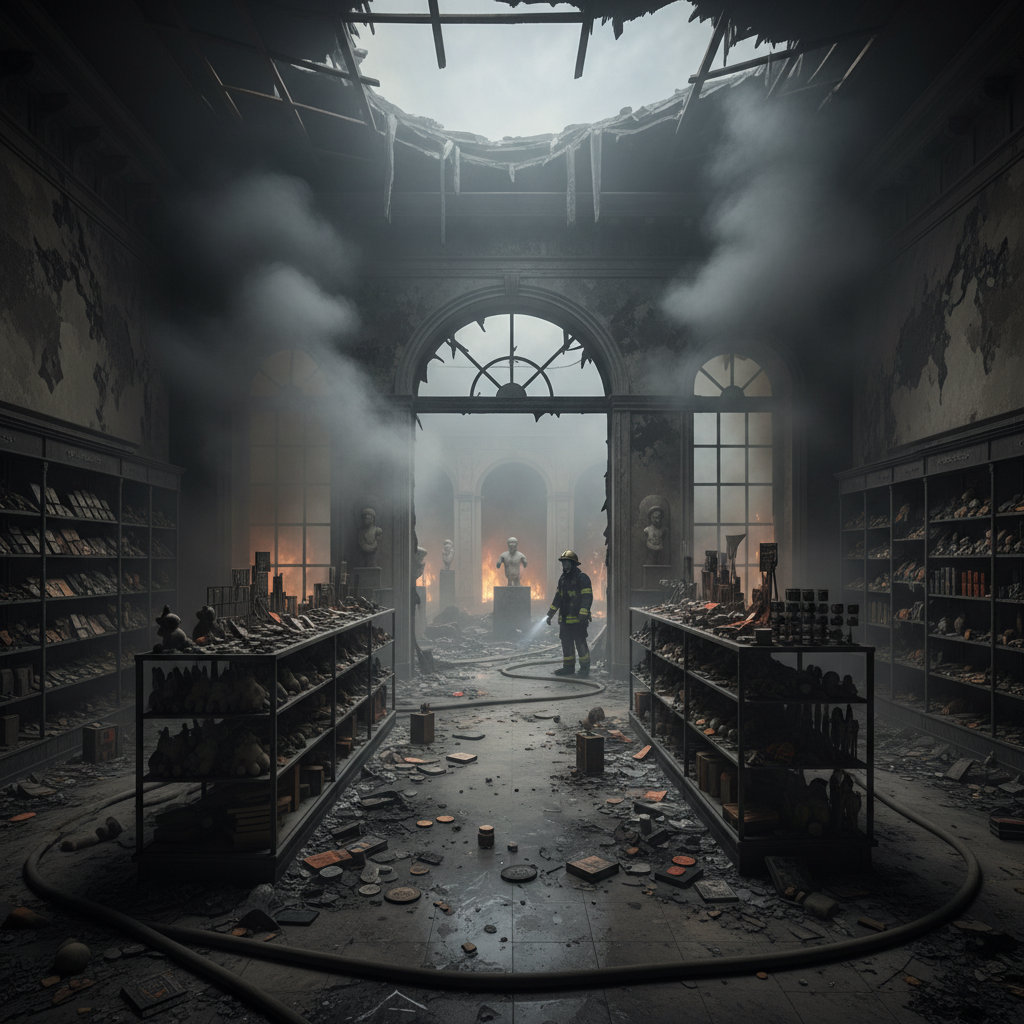
One of Los Angeles’s most beloved and unusual cultural institutions has been left reeling in the aftermath of a massive fire that broke out late at night earlier this month. According to LAist, the fire, which destroyed the Museum of Jurassic Technology’s gift shop and caused smoke damage throughout many of the institution’s exhibits, occurred on the night of July 8. Revenue losses incurred while the museum is shut down are expected to total $75,000. A reopening date is yet to be determined, but we are hopeful for sometime next month.
Situated in the city of Culver City, the Museum of Jurassic Technology (MJT) has for decades occupied a unique and cultishly adored position in LA’s cultural ecosystem. Founded in 1988 by David Hildebrand Wilson and Diana Drake Wilson, the museum draws in visitors with its purposefully mystifying and at times outright disingenuous exhibits. Touting itself as being “dedicated to the advancement of knowledge and the public appreciation of the Lower Jurassic,” the museum in reality has relatively little to do with that geologic period. The curatorial conceit is rather an allusion to the Renaissance-era cabinets of curiosity, or wunderkammers, that served as the precursors for the modern museum.
In practice, the MJT has built itself up over the last three decades as a locale that layers fact and fiction in so many dimensions that its visitors often struggle to tell the two apart. The contents of its galleries range from actual historical artifacts and documents to other pieces that, while real in the sense that they were crafted by an identifiable artist or artisan, blur the line between art and pastiche to an unsettling degree. A case in point is one of the museum’s permanent exhibits, which extols the work of Athanasius Kircher, a 17th-century scientist and Jesuit priest whose expansive interests encompassed so many fields that he is remembered in history as something of an archetypical Renaissance man. Another honors the ultra-miniature sculptures of the Armenian-American artist Hagop Sandaldjian, which were so small they could only be displayed inside the eye of a needle and were painstakingly crafted from single human hairs.
Meanwhile, still other displays on view at the MJT’s galleries are much more eccentric still. Dice that were part of the collections of the magician and historian Ricky Jay decompose in one vitrine, while a separate space in the museum titled “The Garden of Eden on Wheels” provides a visual survey of Los Angeles-area trailer parks. Elsewhere, there are stereographic radiographs of flowers, mosaics made from butterfly wing scales so small that they could only be viewed under a microscope, and a collection of strange letters written by amateur astronomers to the staff of the Mount Wilson Observatory between the years of 1915 and 1935. The museum also included a Russian tea room as of 2005, fashioned after a replica of the study of Tsar Nicholas II in the Winter Palace of St. Petersburg.
Fire and Response
A full account of the fire that broke out on the night of July 8 was provided in an article recently published by the author Lawrence Weschler, whose 1996 book Mr. Wilson’s Cabinet of Wonder explored the provenance of many of the MJT’s displays. In it, Weschler explains that the fire was first discovered by David Wilson, the MJT’s cofounder and curator. Wilson resides in a home located directly behind the museum’s main building, and it was from this vantage point that he first noticed smoke coming from the structure. Grabbing two fire extinguishers, Wilson then hurried over to the building in an attempt to extinguish the flames. “A ferocious column of flame,” he later described it to Weschler, was how he saw the blaze “sprouting up through the corner of the building that abuts the street.”
As he neared the structure, however, Wilson found that the extinguishers he had were insufficient to combat the blaze. He was able to salvage some of the nearby books before help arrived, at which point he began to fear that the fire would take the entire building. Fortunately, his daughter and son-in-law were able to arrive with another extinguisher in time to stop the flames before fire department personnel could make it to the location. Wilson was later told that the arrival of the firefighters had been delayed by just a single minute and that, had they arrived, the building would likely have been a total loss.
Though the fire damage was reportedly limited to the museum’s gift shop, smoke quickly made its way throughout the rest of the building. As Weschler relates, Wilson later described the damage from the smoke as if it had been “a thin creamy brown liquid… evenly poured over all the surfaces—the walls, the vitrines, the ceiling, the carpets, and eyepieces, everything.” Such infiltration of smoke represents a particular challenge for a building whose curation itself often hinges on the microscale. The museum’s staff and volunteers have since been working tirelessly to clean the affected areas, but this process is described as painfully slow.
In the interim, Weschler has been encouraging would-be benefactors to donate to the MJT’s general fund, so as to help it recoup some of its losses and continue to pay its staff during the repair process. Weschler emphasized that the museum is “one of the most truly sublime institutions in the country,” and described it as a “fiercely original human institution that exists beyond the precincts of what we think of as ‘science,’, ‘art,’, ‘storytelling,’, or even ‘wit.’”
At this time, it’s unclear when exactly the MJT will reopen, but there is a sense that it will emerge all the more resilient for having survived yet another eccentric challenge.