
- calendar_today August 20, 2025
Carnegie Mellon University researchers have introduced LegoGPT, which is a revolutionary AI model that converts basic textual descriptions into stable Lego constructions. The system stands out by producing Lego designs that match text inputs and enabling physical construction by both humans and robots. LegoGPT works by translating written descriptions like “a streamlined, elongated vessel” and “a classic-style car with a prominent front grille” into detailed sequences of brick placements that create structurally sound Lego models.
An extensive dataset of 47,000 stable Lego designs paired with captions from OpenAI’s GPT-4o serves as the foundation for training an autoregressive large language model. This training process teaches AI how to understand associations between descriptive language and stable Lego configurations, which enables it to predict the next brick to add in a sequence for preserving structural stability.
The Inner Workings of LegoGPT
LegoGPT builds upon large language model principles from platforms like ChatGPT but shifts its prediction focus from words to bricks. The researchers refined Meta’s LLaMA-3.2-1 B-Instruct language model for instruction following and enhanced it with a specialized software that applies mathematical simulations of gravity and structural forces to confirm design stability. The “physics-aware rollback” feature of LegoGPT enables it to detect structural vulnerabilities while designing and enhance outcomes by testing different brick configurations until the model achieves 98.8 percent stability from an initial 24 percent. The AI creates a series of correctly positioned Lego bricks while checking that each new brick does not collide with existing ones and remains within the set construction boundaries. When designers finish their work, mathematical models test whether the design maintains stability without falling.
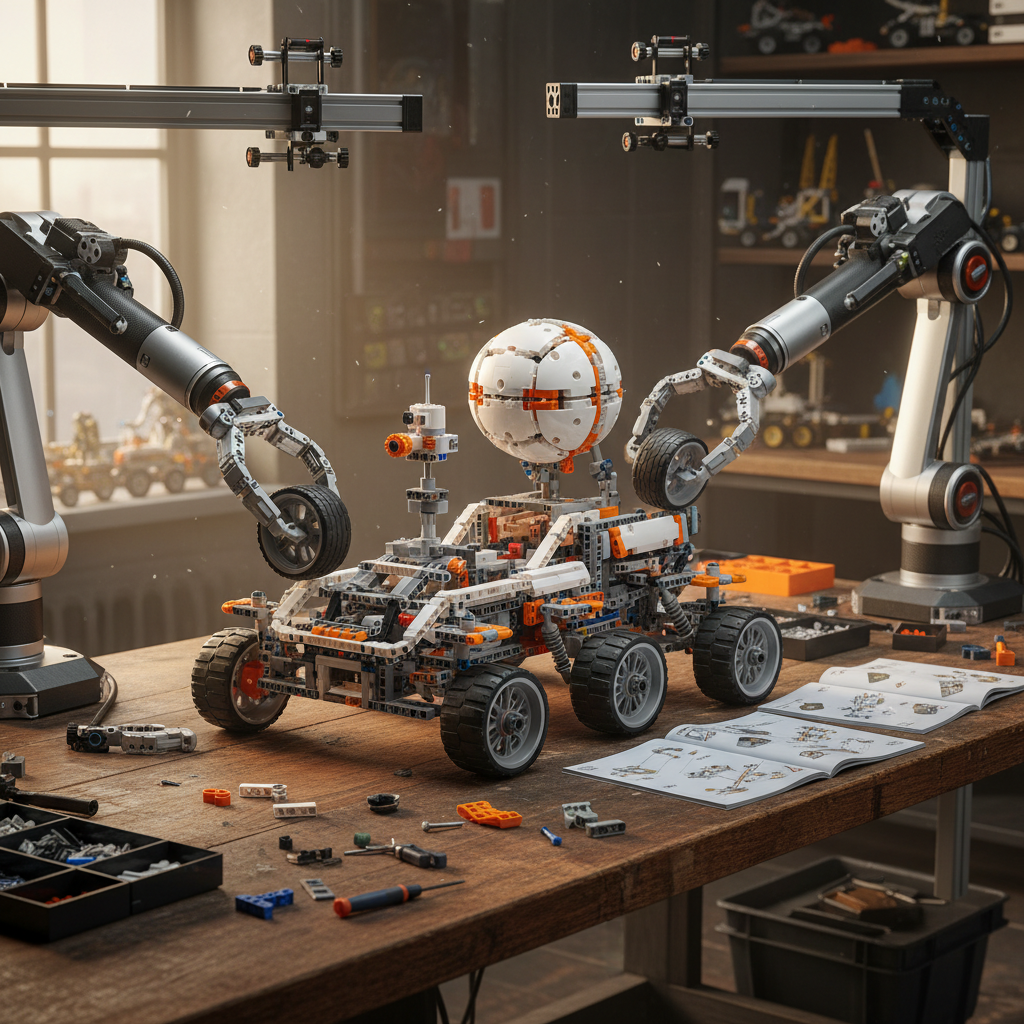
Researchers performed extensive experimentation with both robots and humans to test the practical usability of LegoGPT’s designs. The researchers assembled AI-generated models with a sophisticated dual-robot arm system that had force sensors for precise manipulation following determined brick sequences. The evaluation process included human testers who manually constructed certain AI-designed models to provide proof that LegoGPT generates stable Lego structures that accurately reflect their original text prompts. The experiments proved that the system could transform written descriptions into physical Lego constructions that accurately represented the original designs and maintained necessary structural stability for actual building. The fact that both robots and humans could successfully build structures demonstrates the effectiveness and durability of the AI-generated instructions.
LegoGPT stands out from other AI systems dedicated to 3D design, such as LLaMA-Mesh, by maintaining a strong dedication to structural stability during its operation. The team’s assessments demonstrated that their method produced stable structures at a much higher rate than alternative techniques, which prioritize visual detail instead of physical stability. LegoGPT functions in a limited space measuring 20×20×20 units and uses only eight basic types of Lego bricks.
The research team acknowledges current system constraints while detailing future enhancements to extend its design capabilities to larger and more complex models with diverse brick selections that include slopes and tiles. The planned expansion requires additional refinement of both the AI model and its physics simulation to manage increased design complexity. LegoGPT represents a major advancement in AI-driven design by combining language comprehension with physics simulation to produce physical constructions.
The Broader Implications of LegoGPT
LegoGPT has important applications that reach further than just the creation of Lego models. LegoGPT can convert abstract written instructions into stable and buildable physical structures, which indicates potential uses for architecture and engineering fields. Envision a future where designers use natural language descriptions to create structural components or robotic assemblies, which AI systems turn into exact, buildable instructions that include stability evaluations. Implementing this system will make design workflows faster and error-free while enabling wider access to complex physical object creation. The ongoing development of AI systems such as LegoGPT holds potential to transform design and manufacturing processes throughout multiple industries by merging digital designs more seamlessly with tangible outputs.
LegoGPT marks a major advancement in AI-driven design as it uniquely creates structures that are both visually attractive and structurally feasible based on text inputs. The focus on stability and constructability principles establishes a new standard for AI in physical creation while forecasting a future where AI becomes crucial in transforming digital designs into tangible structures.